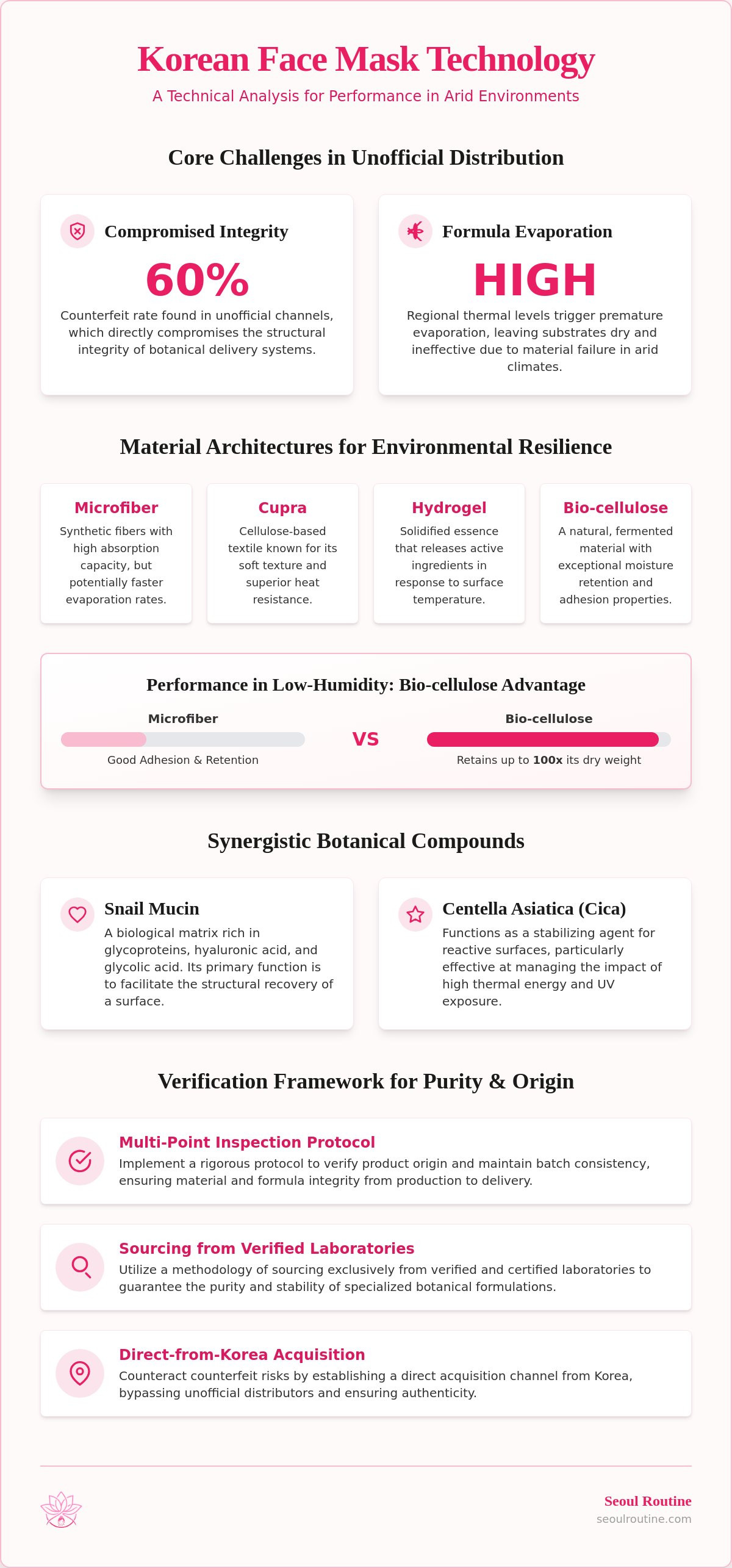
Statistics indicate that unofficial distribution channels for the Korean face mask UAE encounter a 60% counterfeit rate; this directly compromises the structural integrity of botanical delivery systems. It's a reality that high thermal levels in the region often trigger premature formula evaporation, leaving substrates dry and ineffective. This technical failure occurs when standard materials can't withstand the atmospheric pressures of an arid climate. Reliable performance requires a synergy between material science and botanical purity that doesn't falter under the sun.
Scientific data suggests that atmospheric compatibility is the cornerstone of effective hydration. This analysis promises a deep dive into the engineering behind heat-resistant fiber structures and the stabilization of high-purity botanicals. It's a look at the technical evolution of a ritualized delivery system designed for resilience. A detailed breakdown explores the calibration of these systems for local conditions, ensuring that surface hydration and material performance remain optimized. This journey through material integrity provides the clarity needed to identify truly sustainable solutions for a demanding environment.
Key Takeaways
- Discover the engineering behind the occlusive barrier in a Korean face mask UAE and its role in preventing formula evaporation during high thermal exposure.
- Analyze the chemical synergy of Snail Mucin and Centella Asiatica within botanical architectures to ensure precise surface texture refinement and material stability.
- Evaluate how arid atmospheric conditions and indoor air conditioning influence the rate of essence depletion for better environmental calibration of delivery systems.
- Implement a multi-point inspection protocol to verify product origin and maintain batch consistency through direct-from-Korea acquisition.
- Understand the methodology of sourcing from verified laboratories to guarantee the integrity and purity of specialized botanical formulations.
The Technical Specifications of the Korean Face Mask in the UAE
The Korean face mask UAE functions as a precision-engineered textile or hydrogel delivery system designed to optimize the transfer of botanical compounds to a target surface. It operates primarily as a temporary occlusive barrier. This physical shield is critical in preventing the immediate evaporation of volatile ingredients, which is a common failure in standard topical applications within the arid atmospheric conditions of the Middle East. By creating a sealed environment, the mask ensures that the concentrated formula remains in constant contact with the application area, allowing for deeper penetration of nutrients. This technology has roots in the broader innovation cycle of K-beauty, where the focus shifted from simple liquid application to sophisticated material-based delivery.
Material categorization is essential for understanding performance. These systems generally fall into four primary groups:
- Microfiber: Synthetic fibers with high absorption capacity.
- Cupra: A cellulose-based textile derived from cotton linter, known for its soft texture and heat resistance.
- Hydrogel: A solidified essence that responds to surface temperature by melting slightly to release active ingredients.
- Bio-cellulose: A natural, fermented material with a fiber diameter of approximately 20 nanometers.
Material Science: Microfiber vs. Bio-Cellulose
Structural differences between microfiber and bio-cellulose dictate their performance in low-humidity settings. Microfiber utilizes a dense weave that holds a significant volume of liquid; however, its synthetic nature can lead to faster evaporation rates when external moisture is scarce. Bio-cellulose offers a more resilient alternative. Because its fibers are grown through organic fermentation, they possess a natural ability to retain moisture up to 100 times their dry weight. The adhesion mechanics of bio-cellulose are also superior. It's able to conform to the microscopic topography of a surface with extreme precision, creating a physical bond that prevents the formula from escaping into the surrounding air.
The Mechanics of Formula Saturation
A critical factor in the success of a delivery system is the ratio of essence volume to the material surface area. Viscosity analysis reveals how liquid formulas interact with these porous membranes. Lower viscosity essences require tighter fiber structures to prevent leakage, while thicker, gel-like formulas thrive in the open matrices of hydrogel or bio-cellulose. In the UAE, the influence of storage temperature on material integrity is a constant concern. High ambient heat can weaken the polymer chains in hydrogels or cause the premature breakdown of textile fibers. Ensuring these systems are stored below 25 degrees Celsius preserves the structural integrity of the mask and the chemical stability of the botanical essence.
Botanical Architectures: Analyzing K-Beauty Formula Compositions
The internal architecture of a Korean face mask UAE relies on a sophisticated hierarchy of active compounds. These formulas aren't merely liquids; they're engineered solutions designed for sustained surface interaction. Unlike standard topical applications that may lose efficacy due to rapid evaporation, these botanical delivery systems utilize the substrate to maintain a constant pressurized interface. This ensures that the concentration of nutrients remains stable throughout the application cycle, even when external humidity levels drop significantly.
Snail Mucin and Centella Asiatica form a powerful synergy within many high-performance masks. Snail Mucin is a biological matrix rich in glycoproteins, hyaluronic acid, and glycolic acid. These elements work together to facilitate the structural recovery of a surface. Centella Asiatica, often referred to as Cica, serves as a stabilizing agent for reactive surfaces. It's particularly effective at managing the impact of high thermal energy and UV exposure. Brands like COSRX and Beauty of Joseon integrate these components to ensure that the application area remains resilient against environmental stressors.
The Snail Mucin and Centella Asiatica Synergy
The chemical properties of Snail Mucin allow for a unique type of surface sealing. Glycoproteins within the mucin create a protective lattice that holds moisture in place. When paired with Centella Asiatica, the formula provides a dual-action approach: the mucin repairs the structural integrity of the outer layer while the Centella calms the porous interface. This combination is a staple in the Korean face mask UAE market because it addresses the specific needs of surfaces frequently exposed to intense heat and desalinated water systems.
Niacinamide and Vitamin C: Radiance Engineering
Luminosity is achieved through the precise calibration of Niacinamide and Vitamin C. Niacinamide, a form of Vitamin B3, is typically utilized in concentrations between 2% and 5% for effective texture refinement. It works by optimizing the lipid barrier, which is essential for maintaining a smooth surface. Vitamin C adds an additional layer of radiance engineering, though its stability is often a concern when exposed to atmospheric oxygen. The occlusive nature of the mask material protects these antioxidants, ensuring they reach the target depth before oxidation occurs. This process is supported by research on barrier performance, which highlights how occlusion enhances the absorption of water-soluble compounds.
Hyaluronic Acid is another critical component, often included in various molecular weights. High-molecular-weight versions create an immediate moisture shield on the surface, while low-molecular-weight variants provide depth-specific saturation. Traditional elements like Rice and Ginseng complement these modern chemicals. Rice extracts assist in surface brightening, while Ginseng provides saponins that aid in long-term environmental resilience. For those looking to integrate these advanced botanical architectures into a daily habit, it's helpful to explore curated masks that feature these lab-verified ingredients.
Environmental Resilience: Performance in Arid Atmospheric Conditions
The UAE climate presents a rigorous testing ground for any botanical delivery system. High ambient temperatures, often exceeding 40°C, accelerate the kinetic energy of molecules within a formula. This increased energy can lead to the rapid breakdown of complex chemical bonds, particularly in volatile antioxidants. A Korean face mask UAE must maintain stability despite these thermal pressures. Indoor environments don't offer much relief; air-conditioning systems significantly reduce humidity levels, often reaching a range of 0-20%. In such dry states, the rate of essence depletion increases as the atmosphere aggressively draws moisture from any available source.
Intense UV radiation further complicates formula integrity. Solar energy can trigger photo-oxidation in specific botanical extracts like Vitamin C or Green Tea. The occlusive layer of a sheet mask provides a critical physical barrier. It shields the formula from direct atmospheric contact, ensuring the active components remain functional during the transfer process. Without this protection, the essence would likely evaporate or degrade before achieving the desired effect on the target surface. The physical presence of the substrate acts as a cooling mechanism, regulating the temperature of the application area while the formula works.
Thermal Stability of Botanical Essences
Active ingredients have specific temperature thresholds. For example, certain peptides and enzymes begin to lose structural configuration when exposed to temperatures above 30°C for extended periods. Refrigeration serves as a vital intervention, slowing down molecular degradation and preserving the potency of the botanical architecture. For hydrogel materials, excessive heat can compromise adhesion properties. High temperatures soften the polymer matrix, causing the mask to lose its grip on the application area and reducing the efficiency of the delivery mechanism.
Humidity Interaction and Surface Hydration
In low-humidity zones, trans-surface water loss becomes a dominant force. The atmosphere acts as a vacuum for moisture. This makes the balance between humectants and emollients essential. Humectants like Hyaluronic Acid attract water, while emollients create a seal to keep it there. Optimizing the duration of application is also key. If left too long in an arid room, the mask itself may begin to dry, potentially reversing the hydration flow. A 15 to 20 minute window ensures maximum formula transfer without the risk of atmospheric re-absorption. This precise timing is crucial for maintaining the integrity of the target surface in the unique UAE environment.
Verification Frameworks for Authentic K-Beauty Acquisitions
Authenticity within the market for a Korean face mask UAE relies on a rigorous multi-point inspection protocol. Counterfeit material systems pose a significant risk to the structural integrity of a botanical delivery system. These unauthorized replicas often utilize inferior substrates that fail to maintain the necessary occlusive barrier required for arid climates. To mitigate these risks, verification must focus on specific markers of origin. Holographic seals and encrypted QR codes serve as the primary digital fingerprints for authentic units. These tools allow for the immediate confirmation of a product journey from a verified Korean laboratory to the final destination in the UAE. It's a process that protects the chemical architecture of the formula from being compromised by unverified sources.
The UAE regulatory landscape provides an additional layer of security. The "Control Scheme of Cosmetics and Personal Care Products" introduced in August 2025 mandates that all products comply with MoIAT standards. This includes obtaining a Certificate of Conformity (CoC), a process that involves a document review fee of AED 620 and a certificate fee of AED 670. Authentic units will always align with these local regulations, ensuring that the material performance and botanical purity meet the highest engineering specifications. Without these verified frameworks, the risk of essence depletion or material failure increases significantly.
Packaging Integrity and Batch Tracking
The manufacturing date and expiration protocols must be clearly visible on the external packaging. Official brand stamps and the "Made in Korea" label are standard requirements for compliance. Brands like ANUA and AXIS-Y have integrated digital verification tools that cross-reference batch numbers with central databases. This ensures that the botanical purity and material performance meet the original engineering specifications. Batch consistency is only guaranteed when the supply chain remains closed and monitored, preventing the introduction of degraded or counterfeit stock into the inventory.
The Direct-to-UAE Logistics Model
Direct-from-Korea shipping is essential for maintaining the stability of delicate botanical formulas. Bypassing intermediate storage facilities prevents exposure to unregulated thermal environments that can trigger ingredient degradation. A climate-controlled transit system keeps the essence at optimal temperatures, preventing the molecular breakdown often seen in standard shipping methods. Seoul Routine maintains a verified supply chain that ensures every unit arrives with its chemical architecture intact and its material integrity preserved. This direct acquisition model eliminates the uncertainty associated with third-party marketplaces. To ensure a connection to original laboratory standards, view the authentic Korean face mask UAE collection.
The Seoul Routine Methodology: Direct Acquisition from Korea
Reliability in a Korean face mask UAE selection isn't accidental. It's the result of a strict methodology that prioritizes technical performance over market trends. The curation process begins at the source, focusing exclusively on formulations that demonstrate high stability in extreme environments. By maintaining a direct link to verified Korean laboratories, the integrity of every botanical delivery system is preserved. This approach ensures that the molecular structures of active ingredients remain intact from the moment of production until they interact with the target surface. It's a closed-loop system that rejects the uncertainties of third-party warehousing.
The commitment to quality extends to a specific roster of high-performance brands. Names like Beauty of Joseon, COSRX, and ANUA are selected based on their laboratory standards and proven efficacy. These brands provide the foundational architecture for a routine that resists the drying effects of the local atmosphere. Whether the focus is on Cleansers, Serums, or specialized Masks, each item undergoes a vetting process to confirm its botanical purity and material resilience. This selection isn't just about availability; it's about engineering a sustainable maintenance cycle for surfaces exposed to the unique pressures of the UAE. Every formula is an asset in a broader strategy of environmental resilience.
Curated Selection for Environmental Compatibility
Selecting formulas for arid conditions requires a deep understanding of material durability. A substrate must hold its essence even when the surrounding humidity drops to 0%. The testing process evaluates the rate of essence retention and the structural strength of the textile or hydrogel base. Only materials that maintain contact without premature drying are included in the final curation. This focus on high-performance categories ensures that every step, from initial cleansing to final mask application, contributes to a reinforced moisture barrier. It's a system designed to thrive where standard products often fail, providing a consistent result across various atmospheric states.
The Logistics of Authenticity
Direct shipping from Korea to the UAE serves as the ultimate safeguard against counterfeit intervention. By bypassing intermediate storage, the risk of material degradation or the introduction of unverified stock is eliminated. Orders exceeding AED 250 qualify for this direct logistics path, ensuring a seamless transition from the laboratory to the destination. The timeline is optimized to minimize environmental exposure, keeping the chemical architecture of the products stable during transit. This transparent acquisition philosophy provides a verified path for those seeking genuine K-beauty innovation. It's a commitment to quality assurance that prioritizes the performance of the formula and the integrity of the delivery system above all else.
Optimizing Material Performance in Arid Environments
Transitioning from technical understanding to consistent application requires a focus on material integrity and botanical purity. The evolution of the Korean face mask UAE has demonstrated that resilience depends on specialized textile engineering and stabilized formula compositions. These systems ensure that the application area receives optimal hydration even when atmospheric humidity reaches critical lows. Maintaining this level of performance requires a commitment to authentic sourcing and climate-controlled logistics that protect the chemical architecture of the essence from environmental degradation.
Reliable results stem from a supply chain that eliminates intermediate risks and preserves formula potency. Every selection undergoes a process of rigorous verification to confirm the stability of the botanical architecture. Logistics are streamlined through direct shipping from Korea to the UAE, ensuring batch consistency and thermal protection for every unit. For acquisitions over AED 250, free shipping is provided to maintain the flow of high-quality maintenance tools without interruption. It's time to explore the curated selection of authentic Korean face masks at Seoul Routine. Achieving consistent surface maintenance is a matter of precision and trust.
Frequently Asked Questions
How does the material of a Korean face mask affect formula delivery?
The material acts as a physical delivery vehicle that determines the absorption rate and pressure of the botanical formula. Porous textiles like microfiber hold a high volume of liquid, while bio-cellulose provides a nanostructure that conforms to surface topography. These material choices dictate how efficiently a Korean face mask UAE transfers nutrients before atmospheric evaporation occurs.
Why is direct shipping from Korea important for product authenticity?
Direct shipping eliminates the opportunity for counterfeit intervention by bypassing intermediate storage facilities. This logistics model ensures that the product remains within a climate-controlled supply chain from the Korean laboratory to the UAE destination. Bypassing unverified third-party warehouses maintains batch consistency and prevents exposure to unregulated thermal environments that could compromise the chemical architecture of the formula.
Which botanical ingredients are most effective for arid atmospheric conditions?
Snail Mucin, Centella Asiatica, and high-molecular-weight Hyaluronic Acid are most effective for maintaining surface integrity in dry climates. These ingredients function as humectants and emollients, creating a moisture lattice that resists the vacuum effect of low humidity. Traditional elements like Rice and Ginseng complement these by providing saponins and antioxidants that aid in long-term environmental resilience against intense solar energy.
Can high temperatures in the UAE degrade the essence within the packaging?
Thermal energy above 30°C can trigger the molecular breakdown of active enzymes and volatile antioxidants within the packaging. In the UAE, where ambient temperatures often exceed 40°C, the chemical stability of the essence is at risk if not stored in a regulated environment. Refrigeration is a practical intervention that preserves the structural configuration of peptides and prevents the oxidation of brighteners like Vitamin C.
What is the recommended duration for mask application in low-humidity environments?
An application window of 15 to 20 minutes is recommended to maximize formula transfer without risking atmospheric re-absorption. In environments where humidity levels are between 0-20%, leaving a substrate on for too long can cause the material to dry and draw moisture away from the target surface. Precise timing ensures the occlusive barrier functions as intended before the essence depletion reaches a critical threshold.
How can the origin of a K-beauty product be verified through its packaging?
Verification is achieved by inspecting holographic seals, encrypted QR codes, and "Made in Korea" stamps. These markers allow for a digital cross-reference with brand databases to confirm the manufacturing date and batch number. Compliance with the UAE's "Control Scheme of Cosmetics and Personal Care Products" also requires a Certificate of Conformity (CoC), which serves as a regulatory hallmark of authenticity.
Are hydrogel masks more effective than microfiber masks in the heat?
Hydrogel materials offer superior thermal regulation as the solidified essence melts slightly upon contact with a surface. While microfiber has a high absorption capacity, it's more prone to rapid evaporation in low-humidity air-conditioned rooms. Hydrogel provides a more resilient physical seal, although it requires strict temperature control during storage to prevent the softening of its polymer matrix.
What role does Niacinamide play in surface texture modification?
Niacinamide modifies surface texture by optimizing the lipid barrier and refining the outer protective layers. At concentration levels between 2% and 5%, it assists in maintaining a smooth interface and reducing the impact of environmental stressors. This ingredient is a core component of the formula because it enhances luminosity without compromising the structural integrity of the application area.