What if the secret to a uniform surface isn't found in aggressive abrasion, but in the precise calibration of molecular inhibitors? Many formulations fail to reach the deep layers of pigment accumulation, leaving substrates mottled and dull. Selecting the best Korean serums for hyperpigmentation requires an understanding of how botanical extracts and lab-synthesized compounds interact with environmental heat. In the high-temperature climate of the UAE, product stability becomes the primary barrier to achieving a radiant, even tone.
It's frustrating when a promising solution degrades under the intense desert sun or fails to deliver on its brightening claims. This guide provides a curated selection of verified brightening serums designed to withstand extreme conditions while restoring surface uniformity. It'll explore the synergy between ingredients like niacinamide and tranexamic acid, ensuring every drop contributes to a stable and luminous finish. Expect a clear path toward identifying high-stability formulations that maintain their molecular integrity from the first application to the last.
Key Takeaways
- Identify the environmental triggers that cause oxidative stress and lead to the localized accumulation of pigment on outer surfaces.
- Explore how the best Korean serums for hyperpigmentation use molecular inhibitors to prevent pigment transfer to the outermost layers.
- Evaluate the performance of various vitamin C derivatives in maintaining surface clarity and providing robust antioxidant protection.
- Master the ritual of layering formulations from lowest viscosity to highest molecular weight to optimize surface integrity.
- Understand why it's vital to use direct sourcing to ensure the stability of molecular solutions in the high-heat UAE climate.
Understanding Pigment Accumulation and Atmospheric Interactions
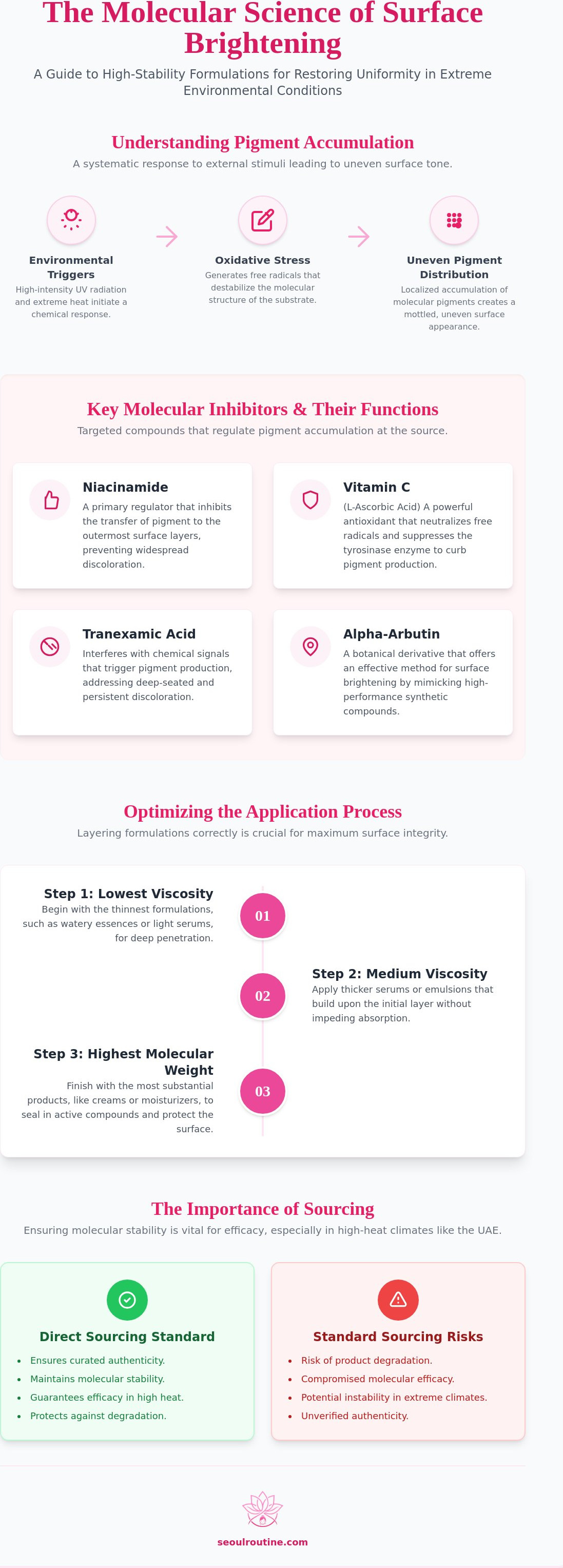
Surfaces exposed to high-intensity light undergo a series of complex chemical shifts. Hyperpigmentation serves as a technical descriptor for the localized accumulation of molecular pigments within the outer layers of a substrate. It's not a random occurrence. Instead, it's a systematic response to external stimuli. When high-intensity UV radiation interacts with a surface, it initiates oxidative stress. This process generates free radicals that destabilize the molecular structure, leading to an uneven distribution of pigment across the material.
The atmospheric conditions in the UAE present a unique challenge for surface maintenance. Extreme heat acts as a catalyst, accelerating the internal production cycles that lead to visible darkening. Without precise molecular intervention, these cycles often become persistent. Disruption of these pathways is essential to restore uniformity. Identifying the best Korean serums for hyperpigmentation involves finding formulations that remain stable despite these environmental pressures. A stable formulation ensures that the active compounds reach the target area without degrading before they can perform their intended function.
The Mechanism of Melanin Synthesis
Tyrosinase activity functions as the central engine for pigment production. This enzyme facilitates the conversion of specific amino acids into molecular pigments, which then migrate through the structural layers to the outermost surface. Persistent environmental triggers, such as constant UV exposure, create a feedback loop. This signaling ensures that the synthesis process remains active long after the initial trigger has passed. What begins as a temporary adjustment to light exposure eventually transitions into a deep-seated accumulation. This structural change requires targeted compounds to inhibit the enzymatic process and restore clarity to the material.
Environmental Factors in the UAE
The impact of high heat extends beyond simple pigment triggers. Sustained high temperatures can lead to the degradation of surface protective barriers. When these barriers weaken, the underlying layers become increasingly susceptible to atmospheric damage. Humidity also significantly influences the absorption rates of active molecular compounds. High moisture levels in the air can alter the viscosity and penetration depth of topical solutions. Because of these factors, standard brightening solutions often require regional optimization to remain effective. Ensuring that a formulation can withstand the UAE’s specific climate is a critical component of the vetting process.
The Molecular Science of Brightening: Key Botanical Inhibitors
Achieving surface clarity involves more than superficial application. It requires a strategic disruption of the chemical pathways responsible for localized darkening. The best Korean serums for hyperpigmentation prioritize molecular precision to ensure that pigment accumulation is regulated at the source. Demystifying hyperpigmentation reveals that successful outcomes depend on inhibiting specific enzymatic reactions within the substrate layers. By addressing these pathways, it's possible to restore a uniform appearance to the outer material.
Niacinamide acts as a primary regulator by inhibiting the transfer of pigment to the outermost surface layers. It ensures that synthesized melanin remains localized rather than spreading across the substrate. Vitamin C, specifically in the form of L-Ascorbic Acid, serves as a powerful antioxidant. It neutralizes free radicals and suppresses tyrosinase, the enzyme that initiates the darkening process. For more stubborn, deep-seated discoloration, Tranexamic Acid provides a sophisticated molecular approach by interfering with the chemical signals that trigger pigment production. Botanical derivatives like Alpha-Arbutin offer a gentle yet effective method for surface brightening by mimicking high-performance synthetic efficacy without the same structural stress. Additionally, Snail Mucin introduces natural glycoproteins that support surface restoration and texture uniformity. These compounds work together to refine the substrate and maintain structural integrity. Exploring a curated selection of serums ensures that every choice is backed by molecular research and verified stability.
Synergy Between Active Compounds
Combining Niacinamide and Vitamin C allows for dual-action pigment regulation. While one inhibits transfer, the other suppresses synthesis. To maintain surface stability during active treatment, Centella Asiatica provides a calming effect, preventing the oxidative stress that can lead to further darkening. Rice Ferment Filtrate acts as a natural delivery system, enhancing the penetration of larger molecules and ensuring that active ingredients reach the necessary depth within the substrate.
Stability and pH Requirements
The efficacy of acidic brightening agents depends heavily on pH balance. If the environment is too alkaline, molecules like Vitamin C can become inactive or cause surface degradation. Protecting unstable molecules from light and heat-induced oxidation is particularly critical in high-temperature climates like the UAE. Advanced Korean formulations often employ encapsulation technologies. This process shields sensitive actives in protective shells, allowing for a controlled release that maintains molecular integrity until the point of contact with the surface.
Comparative Analysis of High-Performance Korean Formulations
Selecting between high-performance options requires a detailed look at concentration and chemical synergy. Niacinamide-heavy serums excel at surface texture refinement. They work by smoothing the substrate while regulating pigment transfer. In contrast, Vitamin C derivatives offer robust antioxidant protection. These molecules are essential for maintaining clarity when surfaces are exposed to the intense light typical of the UAE. Scientific research highlights several effective treatments for hyperpigmentation that rely on these core actives to disrupt darkening cycles. By evaluating the specific molecular weight of these ingredients, it's possible to predict how effectively they'll integrate with the structural layers of the material.
Multi-acid formulations provide a more aggressive approach for rapid surface restoration. By combining alpha-hydroxy acids with brightening agents, these solutions accelerate the removal of darkened outer layers. This process reveals the clearer material beneath much faster than single-active serums. For long-term pigment maintenance, botanical extracts like licorice root or green tea provide a steady, non-disruptive influence. These extracts ensure that the substrate remains uniform without the risk of over-processing. Identifying the best Korean serums for hyperpigmentation often means finding a balance between these rapid-acting acids and stabilizing botanicals. Recent data from late 2025 shows a 53% increase in the popularity of PDRN-based serums, suggesting a shift toward ingredients that focus on deep-level structural restoration alongside surface brightening.
Spot-Targeting vs. Full-Surface Brightening
Localized pigment correction often utilizes high-concentration ampoules. These are designed for intense regulation on specific areas of darkening where pigment accumulation is most dense. Conversely, lightweight, full-surface serums promote overall clarity. They're ideal for maintaining a consistent tone across the entire substrate and achieving the "cloudglow" finish popular in 2026. Choosing between them depends on whether the goal is to address specific clusters of pigment or to enhance the luminosity of the entire surface. Many modern routines now favor a strategic 4-5 step process that utilizes multi-active products to cover both needs simultaneously.
Formulation Texture and Absorption
In the humid environments of the UAE, water-based serums are preferred for their rapid penetration. They don't leave a heavy residue on the surface, which is crucial when layering subsequent protective products like sunscreens or moisturizers. Viscous formulations, however, allow for a sustained release of active ingredients over several hours. This is particularly beneficial for molecules that require a longer contact time to inhibit tyrosinase activity effectively. The interaction between serum texture and the final protective layer determines how well the actives are retained within the structural layers, preventing evaporation in high-heat conditions.
Optimization of the Application Ritual for Maximum Surface Integrity
The success of any molecular intervention depends entirely on the state of the receiving surface. To ensure the best Korean serums for hyperpigmentation reach their full potential, the substrate must be free from residues and atmospheric pollutants. Precision in the sequence of application ensures that active molecules don't encounter structural barriers before reaching their target layers. It's not just about what is applied, but how the layers are integrated into the surface environment.
Start with the lowest viscosity formulations. These water-based solutions penetrate rapidly, filling the microscopic gaps in the surface structure. Waiting approximately 30 to 60 seconds between layers allows each formulation to settle without being diluted by the next. As the molecular weight of the products increases, the layers become thicker, acting as sealants for the previous actives. This methodical build-up maintains surface integrity while delivering high-concentration inhibitors deep into the substrate.
In the UAE, the intensity of the light cycle makes high-SPF protection a mandatory final step. This is especially true given the 2026 standards for cosmetic safety and efficacy. Without this shield, the molecular work of the serum is undone within minutes of exposure. A broad-spectrum barrier prevents the re-triggering of pigment production. It ensures that the substrate remains protected from the oxidative stress caused by high-heat environments, allowing the brightening agents to function without interruption.
The Role of Cleansing in Surface Clarity
Removing surface debris is the first step in any successful routine. A clean surface allows brightening molecules to move freely without being trapped by oxidized oils or dust. Utilizing The Ultimate Guide to Korean Cleansers for Every Skin Type in the UAE (2026) provides the necessary foundation for this process. It's vital to avoid over-exfoliation, as a damaged surface barrier cannot effectively retain moisture or active ingredients. A balanced cleansing ritual prepares the substrate for the complex molecular interactions that follow.
Night vs. Day Application Strategies
Strategic timing aligns the application with environmental cycles. Photosensitive molecules, such as certain Vitamin C derivatives, are often best utilized during low-light cycles to prevent degradation. Conversely, building antioxidant defenses during peak UV exposure periods provides a sacrificial layer. This layer neutralizes free radicals before they can trigger pigment accumulation. Consistency in these rituals ensures that the pathways of discoloration remain disrupted around the clock, leading to a sustainable and uniform surface. Explore the full range of high-stability serums to find the perfect match for surface restoration needs.
The Seoul Routine Standard: Curated Authenticity and Direct Sourcing
Molecular stability is the cornerstone of effective surface restoration. When identifying the best Korean serums for hyperpigmentation, the origin of the formulation is just as critical as the ingredients listed on the label. High-performance actives like pure Vitamin C and certain botanical extracts are sensitive to environmental shifts. Direct-from-Korea sourcing ensures that these compounds don't undergo premature degradation during extended storage or improper transit. By maintaining a short, controlled supply chain, the structural integrity of every molecule remains intact until the moment of application on the substrate.
The marketplace often faces challenges with unverified or counterfeit molecular solutions that lack the necessary potency for surface clarity. Ensuring authenticity is a technical requirement for success. Every formulation in this selection undergoes rigorous vetting to confirm it meets the safety assessments institutionalized in 2026. This process includes testing for stability within the specific high-heat conditions of the UAE. A commitment to professional authority means that only curated, verified items are presented, removing the uncertainty often associated with atmospheric degradation and supply chain inconsistencies.
Direct Shipping and Formulation Freshness
Rapid transit from Korea acts as a safeguard for chemical potency. It reduces the time formulations spend in environments that could trigger oxidation. Proper storage at every stage of the lifecycle is essential, especially for brightening serums that rely on delicate pH balances. By utilizing controlled supply chains, the risk of molecular breakdown is minimized. This ensures that the active inhibitors arrive in the UAE with the same efficacy they possessed at the point of manufacture, ready to disrupt pigment accumulation cycles effectively.
Building a Reliable Maintenance Ritual
Accessing a curated selection of reputable brands like COSRX, ANUA, and AXIS-Y provides a reliable foundation for any maintenance ritual. These brands are recognized for their precision in addressing localized darkening and surface mottledness. Seoul Routine functions as a knowledgeable guide, selecting only the formulations that demonstrate high-stability and clear results. This methodical approach to curation ensures that the restoration of surface uniformity is both predictable and sustainable. Explore the curated collection of authentic Korean serums for surface clarity to ensure every application contributes to a refined and luminous finish.
Achieving Enduring Surface Clarity
Restoring surface uniformity requires a technical approach to molecular inhibition and environmental protection. By selecting formulations that disrupt pigment accumulation at the source, it's possible to maintain a clear and luminous substrate despite the high-heat conditions of the UAE. Success depends on the synergy of stable ingredients and a methodical application ritual that prioritizes molecular weight and viscosity. Finding the best Korean serums for hyperpigmentation ensures that the outer layers remain resilient and visually consistent.
Authenticity is vital to prevent the degradation of active compounds. Every formulation in the collection is tested for stability in desert climates and shipped directly from Korea to preserve maximum molecular potency. Orders exceeding AED 250 qualify for free shipping, making it easier to maintain a consistent restoration cycle. Browse the full collection of authentic Korean serums shipped directly from Korea to begin the transition toward a more radiant and uniform surface. A clear, balanced substrate is within reach through precise science and curated quality.
Frequently Asked Questions
How do Korean serums regulate pigment accumulation differently than Western brands?
Korean formulations prioritize synergistic botanical inhibitors rather than relying solely on high-percentage abrasive acids. Identifying the best Korean serums for hyperpigmentation often involves finding these combinations of niacinamide with licorice root or rice ferment. This approach ensures long-term stability and a gradual restoration of clarity. By focusing on the prevention of pigment transfer, these solutions offer a balanced method for maintaining substrate uniformity.
What is the most stable molecular form of Vitamin C for high-heat environments?
Sodium Ascorbyl Phosphate and 3-O-Ethyl Ascorbic Acid are the most stable derivatives for high-heat environments like the UAE. Unlike pure L-ascorbic acid, these forms are less prone to oxidation when exposed to light and elevated temperatures. They maintain their molecular structure longer, ensuring consistent antioxidant protection. This stability is crucial for preventing the degradation of the formulation before it can interact with the target surface layers.
Can Niacinamide and Vitamin C be utilized within the same application sequence?
Modern molecular engineering allows niacinamide and vitamin C to be utilized within the same application sequence without loss of efficacy. It's best to apply the vitamin C formulation first, allowing it to settle before layering the niacinamide-based serum. This combination provides a dual-action approach to surface brightening. While one suppresses pigment synthesis, the other inhibits the transfer of synthesized pigment to the outer layers of the substrate.
How long is the typical cycle for visible surface restoration when using brightening molecules?
Visible surface restoration typically requires a cycle of 4 to 8 weeks of consistent application. This timeframe aligns with the replacement cycle of the substrate layers. While some lightweight serums provide immediate luminosity, deep-seated pigment accumulation requires sustained molecular intervention to show structural change. Consistent use of the best Korean serums for hyperpigmentation ensures that new layers emerge with greater clarity and a more uniform distribution of tone.
Are these formulations compatible with all surface types in the UAE climate?
Most Korean brightening formulations are compatible with a wide range of surface types, though viscosity plays a significant role in performance. In the humid UAE climate, water-based serums are often preferred to prevent residue build-up. Drier environments may require more viscous, oil-in-water emulsions to maintain hydration while delivering active inhibitors. Every product is vetted to ensure it remains stable and effective under regional atmospheric pressures without causing structural stress.
What is the role of Tranexamic Acid in addressing persistent surface discoloration?
Tranexamic acid functions by disrupting the chemical signaling pathways that trigger persistent pigment production. It's particularly effective for addressing deep-seated discoloration that hasn't responded to standard brightening agents. By interfering with the interaction between different layers of the substrate, it prevents the over-synthesis of pigment. This sophisticated molecule provides a targeted solution for restoring clarity to areas with dense, localized accumulation that appears resistant to other treatments.
Why is direct sourcing from Korea essential for product efficacy?
Direct sourcing from Korea ensures that formulations haven't been subjected to prolonged storage in unmonitored conditions. Freshness is vital for the potency of active brightening molecules, which can degrade if exposed to heat or light during long transit cycles. By maintaining a direct supply chain, every item retains its molecular integrity. This guarantee of authenticity is essential for achieving the predictable results expected from high-performance Korean technology.
Is it necessary to utilize a protective barrier (SPF) after applying brightening serums?
Utilizing a high-SPF protective barrier is mandatory after applying any brightening serum. Without this shield, UV radiation will trigger immediate oxidative stress, undoing the molecular work of the inhibitors. A broad-spectrum barrier prevents the reactivation of pigment synthesis pathways. It ensures that the surface remains protected from external triggers, allowing the active compounds to focus on restoring clarity rather than constantly neutralizing new environmental damage.